The Thursday Style section of the New York Times has a lovely running column called "Boite," in which a new bar is profiled in a series of piquant bullet points. I've always admired it. Recently, I got to write one. Here it is:
Showing posts with label cocktails. Show all posts
Showing posts with label cocktails. Show all posts
Tuesday, November 20, 2012
Boite: Dear Bushwick
The Thursday Style section of the New York Times has a lovely running column called "Boite," in which a new bar is profiled in a series of piquant bullet points. I've always admired it. Recently, I got to write one. Here it is:
Thursday, November 8, 2012
Drinking History

I am a considerably more educated man today than I was a month ago, when I started doing research for this article. Since that time, I've sampled a 1950s Chartreuse, a few blended Scotches from the 1960s, a few gins from the 1940s and '50s, a Cognac from the '60s, a Creme de Menthe from the 1940s, Bourbons from the '60s, '70s and '80s and even an aged vermouth.
Conclusion of all this learning: the old saw that spirits don't change once bottled is nonsense. They grow softer, more rounded, more integrated. Even more untrue is the notion—put forth by nearly every liquor company on earth—that they have made the same product year in and year out. The assertion is not only improbable, but impossible. Improbable, because recipes alter with changing times and changing tastes, not to mention adjusted quality standards. Impossible because no company has consistent access to the exact same grains and botanicals.
We live in a time of great, across-the-board quality in spirits. Still, based on what I sipped, it does seem that some things were done better in the past. The creme de menthe did not taste chemical, as its counterparts of today do. It was fresh and clean. It tasted like something, well, you'd want to drink. I like Gordon's Gin. It's a fine workhorse London Dry gin. But the specimen from the '50s I had was fuller and much more interesting. And the '60s Hennessy I savored had a restraint and dignity that one no longer finds in the sugar-bomb, major-label Cognacs of today. I wish I could drink more of this stuff. But, at $150 a drink, it's a pricey habit.
Here's my article from the New York Times:
Friday, July 13, 2012
Bar Innovations Continue to Confuse Regulators

Last week, it happened again, and the new East Village bar Gin Palace was the victim. The bar, which focuses on gin drinks, trumpeted its draft cocktail program in the press. It would serve Gin & Tonics and Ramos Gin Fizzes on tap. To the drink world, this was not new news. Draft cocktails have been on offer at saloons on both coasts for more than a year now, following in the footsteps of the draft wine trend. In fact, Gin Palace owner Ravi DeRossi has actually featured draft drinks at two of his previous bars. But it was Gin Palace that set the authorities off, mainly because it received so much pre-opening ink.
So now Gin Palace has to argue its case before a hearing. If the bar succeeds, as it should, a lot of other bars with draft programs should be grateful. Here's the item I wrote for the Times' Diner's Journal:
Tuesday, March 20, 2012
The Butterfly to Feature Eben Freeman's Greatest Hits

Eben Freeman has worked the bars of a great number of place over the last two decades, including Eleven Madison Park, WD-50 and Tailor. At present, he managed the beverage programs at all of Michael White's restaurants, but he is not actually behind any particular bar.
With the arrival of White's new Wisconsin-themed restaurant this summer, it will be possible to drink up all the Freeman you want in one location. The Tribeca eatery will have a special cocktail list of many of the drinks Freeman has created at his other jobs, including his famous smoked Coke highball, The Waylon, on tap.
I wrote up his plans for Diner's Journal. Read:
Bartender Will Bring His Busy Past to The Butterfly
By ROBERT SIMONSON
The bar program at The Butterfly — the new Michael White restaurant scheduled to open in TriBeCa this summer — will be part Wisconsin, part Eben Freeman.
Reporting about the plans on Friday, Diner’s Journal noted that Mr. Freeman is “head of bar operations and innovation” at Mr. White’s Altamarea Group. But before holding that position he tended bars at a number of significant New York restaurants and taverns, including Wylie Dufresne’s WD-50and Sam Mason’s Tailor. After The Butterfly opens and settles into a groove, he would like to offer a separate cocktail menu that would comprise a sort of Freeman’s greatest hits.
“We’ll start out without it,” he said in an interview on Monday. “But as soon as we’re comfortable, I’d like to have all the drinks I’ve done in my career in a book behind the bar.”
That book may include: a rum punch he created 20 years ago at Caribe, a West Village restaurant where he got his start; forgotten classics like The Millionaire and American Beauty that he introduced to diners at Eleven Madison Park; The Royal Blush, a blend of vodka, sparking wine and cherry purée that was a popular favorite at WD-50 (“When you add the wine, the drink changes color from pink to red”); The Crumble, a rum drink that was an early example of the now-common technique of fat-washing spirits; and The Waylon, the bourbon and smoked Coke drink made famous at Tailor. “I would like to serve The Waylon on draft,” Mr. Freeman said.
With The Butterfly, Mr. White intends to evoke the supper clubs of his native Wisconsin. (The name comes from The Butterfly Club, a restaurant Mr. White worked at in Beloit, Wis.) The regular cocktail list is still in development. But, even at this early stage, it is certain to bear a couple of Badger State touches.
Mr. Freeman has been collaborating with the owners of Lakefront Brewery, a Milwaukee-based craft brewer. Their first creation, Birra Morini — a light lager made with herbs, including oregano, instead of hops — is already being poured at Mr. White’s Osteria Morini. The debut of a second brew, called Fernet Stout, will most likely coincide with the opening of The Butterfly.
“I thought of making an amaro stout, a licorice stout,” Mr. Freeman said. “Then I thought, Fernet being such a huge thing among mixologists, it would be stupid to call it amaro stout. I should just call it Fernet stout.” The beer is brewed with star anise, fennel seed, clove, saffron, orange peel, and lemon verbena.
And, of course, the menu will boast a brandy old-fashioned, the brandy spin on the classic cocktail that is peculiar to Wisconsin and all but the state’s official drink.
“I’d love to do a grasshopper and all those stodgy drinks, but do them well,” said Mr. Freeman.
Wednesday, February 22, 2012
Smoke 'Em If You've Got 'Em


There were so many that I didn't have room in the article to mention them all. Left out were the Amaro at The Aviary in Chicago, in which the upturned glass soaks up the fumes of a smoldering barrel stave; the Smokin' Bone at Fatty 'Cue, which used smoked pineapple juice; and Embers Only, a smoky Old Fashioned variation at Bobo in the East Village.
The trend is not necessarily new. As I mention in the story, Eben Freeman was working with smoke Coke syrup at Tailor five years ago. Smoke Signals, an early example of smoked ice, was created by Evan Zimmerman at the Teardrop Lounge in Portland soon after. And Andrew Bohrer, the original bar manager at Seattle's Mistral Kitchen, helped come up with the Courting Rachel two years ago. But the trend really picked up a head of steam this past fall.
Are these drinks really worth the bother or their ornate preparations? Well, as with any drinks trends—vinegar cocktails, barrel-aged cocktails, fat-washed cocktails, draft cocktails—it depends on who's behind the bar. In the hands of a bartender who knows what he's doing, they can be sublime. In the hands of an amateur, they're often unbalanced and just plain curious. The best specimens I tasted were made by Derek Brown and his people down in D.C.
Here's the New York Times story, accompanied by some splendid photography.
Where There's Smoke, There's a Bartender
ON a recent episode of the satirical IFC show “Portlandia,” a preening mixologist creates an over-the-top cocktail with egg shells, a rotten banana and “charred ice.”
Good joke, but not completely absurd. Charred ice has not been spotted in any mixing tins, but smoked ice cubes are falling into cocktails in Boston, California and, yes, Portland, Ore.
Mixologists have been using mezcals and peaty Scotches to slip a little smoky flavor into their potions for some years. But today many bartenders will settle for nothing less than actual smoke.
At Craftbar in Manhattan, the beverage director, Hayden Felice, is smoking the Campari in the house Negroni. For the Smoked Sicilian Manhattan at the Bristol, in Chicago,bourbon is given a cherry-wood treatment. At Rogue 24, R. J. Cooper’s restaurant in Washington, D.C., the mixologist Derek Brown pumps cassia-bark fumes into a blend of mezcal, maple syrup and maple bitters called Where There’s Mezcal. And the Smoky Margarita at Bottega in Yountville, Calif., has no less than three sources of smoke: smoked tequila, smoked jalapeño simple syrup and oak-smoked salt on the rim.
Sound a bit byzantine? It gets better. At Mr. Brown’sColumbia Room in Washington, a new drink called Ghost Dance gets going when aromatic sweetgrass (also called bison grass) and a star anise pod are set smoldering under an upturned glass. After the vessel has been thoroughly “rinsed” with the vapors, this Sazerac variation is completed with Calvados, Fernet-Branca and simple syrup.
But even that process takes a back seat to the Smoker’s Delight, served at Todd Thrasher’s bar PX in Alexandria, Va. Mr. Thrasher takes three or four different kinds of tobacco, steeps them in hot water for five minutes, strains it, adds sugar and reduces the mixture. He mixes a few drops of this with bourbon, honey syrup and lemon juice. Mr. Thrasher created the cocktail for his business partner, who had just quit smoking.
“I think it adds another nuance of flavor,” Mr. Thrasher said. “Smoke has always been in food. In cocktails, unless you used mezcals and Scotches, you don’t get it. It’s me trying to move beyond really sweet and really dry cocktails.”
There are as many ways to deliver embers to alcohol as there are woods to burn. The most common tool (and the simplest method) is the smoke gun. Stuff wood chips in the device’s chamber, light them, and the smoke snakes through a tube to its desired target.
This is how Amber Johannson, at Mistral Kitchen in Seattle, treats the bourbon for the Courting Rachel, her take on an Old-Fashioned. After filling a decanter with smoke, she chases it with the mixed drink, then pours the result over rocks.
Craftbar has a smoker in the restaurant, which Mr. Felice uses to give near-frozen Campari an hourlong apple-wood singe. For their Mexican Piano cocktail, Tim Zohn and Ethan Terry at AQ in San Francisco take a blowtorch to a bay leaf and immediately pour ice over it to trap the smoke in the glass. They then pour in the cocktail, a mix of tequila, lime juice and huckleberry-tarragon syrup.
For customers, the appeal of these drinks may go beyond flavor to something more subliminal.
“The first thing you think about is camping,” said Mr. Brown, the mixologist. “It has an emotional impact.”
Eben Freeman, the director of bar operations and innovation at the Altamarea Group, is familiar with the notion.
“I’m sure that people will argue it’s some sort of caveman reaction,” he said. “That sense-memory thing is part of its appeal. I think it’s also a matter of the American palate, which has changed and is on such a fast learning curve. You overload that palate, so you need stronger and stronger flavor experiences.”
Mr. Freeman should know. Those smoke signals bartenders are reading can arguably be traced back to Tailor, the bygone SoHo restaurant where Mr. Freeman was the barman. Tailor’s best-selling drink was the Waylon, a simple but bewitching mix of bourbon and smoky Coke. Drafting off the chef Sam Mason’s root beer float, made with smoked vanillaice cream, Mr. Freeman did the same to Coke syrup, smoking it first with cherry wood, then alder, then feeding it through his bar’s soda gun.
“A lot of things that people scoffed at when they happened, they’re doing a lot now,” Mr. Freeman said. “It’s been a delayed effect.”
Like Mr. Freeman, many of the mixologists now playing with fire took their tip from the kitchen, adopting processes and equipment once reserved for the chef.
“We saw them playing with blowtorches and wondered why they should have all the fun?” Mr. Zohn said.
Bartenders are also finding new nonflammable ways to introduce a fireplace aura. Lapsang souchong tea, which Mr. Thrasher said “smells like Laphroaig tea,” is a favorite. He mixes some with single-malt Scotch, lemon juice and honey syrup to make his Sherlock Holmes cocktail.
Greg Seider, owner of the Summit Bar in the East Village and a cocktail consultant, uses a secret ingredient he calls Bonfire (a Lapsang souchong nettle tincture) to season the Restoration, a drink at Le Bernardin made with butter-infused Calvados and caraway agave.
Mr. Terry said there might be one other hidden appeal in all these elixirs. “There’s not a lot of smoke in bars anymore,” he said. “These drinks take you back a little bit. It makes it feel a little more like a bar.”
Something to mull over beside the hearth.
Tuesday, January 24, 2012
The View From Houston

It hadn't occurred to me that Houston's cocktail scene might be worth checking out until I interviewed bartender Sean Beck for Wine Enthusiast. Now I think a side trip is in order next time I'm in New Orleans. Here's the interview:
Mixologist of the Month: Sean Beck
Sean Beck keeps his eye on the flat Texas horizon when exploring ideas for the wine, spirits and cocktail lists at the three Houston restaurants where he serves as beverage director. And there’s little that escapes his notice.
While every mixologist knows of Tito’s Handmade Vodka, a Lone Star product that now has a national profile, Beck favors the smaller Dripping Springs Texas Vodka, made outside Austin. He also utilizes Texas whiskey, made by Balcones Distilling in Waco, in some of his cocktails, including the blue corn-based Baby Blue Whiskey and Rumble, a liqueur made from Mission figs, sugar and wildflower honey. But just being from Texas isn’t necessarily enough for a spirit to meet Beck’s approval.
“I love local, but it can’t be local for local’s sake,” he says. “That’s not good enough and that’s always been the problem with Texas wines. They’ve sold out ferociously, so they haven’t had the pressure to ramp up the quality to where it should be.”
A native of Rochester, New York, Beck has lived in Texas for 22 years. He worked as a waiter at the Backstreet Cafe while in college; by graduation, he’d been promoted to sommelier. Today, he’s responsible for a restaurant group that includes Hugo’s and Trevisio.
Beck thinks Houston’s greatest strength as a cocktail town lies in what it’s not. “It doesn’t follow rules,” he says. “Once someone does something in New York, everyone knows about it. That’s one of the reasons New York goes through beverage trends and wine trends so quickly. Houston is so spread out that people aren’t cognizant of what other people are doing. So people march to their own drummer.”
Thursday, January 19, 2012
And Cocktails Get Even More Complicated
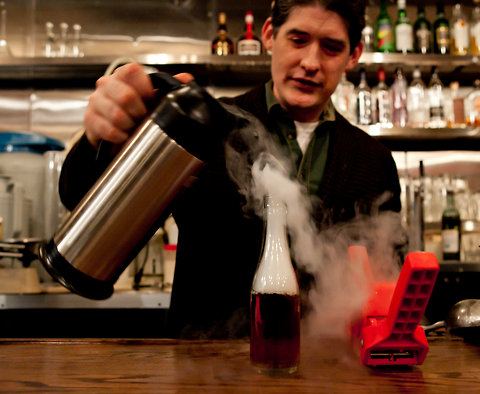
There seem to be two divergent trends going among in the cocktail bars opening recently. One set (Mother's Ruin, Basik) is trying to simplify and render more humble the consumer's craft cocktail experience, while the other (Aviary, Rogue 24) is ramping up the level of ornate experimentation and invention exponentially.
Squarely falling in the second category is Booker and Dax, the new collaboration between superstar chef David Chang and cocktaildom's benevolent mad scientist Dave Arnold, the French Culinary Institute‘s director of culinary technology who has more technology toys that did Fred McMurray in his Disney years. Arnold preaches the simplicity of complication. For him, the old cocktail methods are inefficient and can be solved with a bunch of tubing, gases and open flames. It sounds terribly geeky (and it is), but in Arnold's hand is often infectiously endearing.
Liquid nitrogen, a Red Hot Poker, a centrifuge and a rotory evaporator are Arnold's bar tools of choice. I wrote an article in the New York Times about the bar's imminent opening (see below), but there are a few featured drinks that I couldn't fit into the text. There will be a carbonated Gin & Tonic; and a carbonated drink called Chartruth, a mix of green Chartreuse and lime. Maria de la Noche will be a clear riff on the Bloody Mary, a blend of clarified cherry tomatoes, clarified Worchester sauce, clarified Siricha sauce (all rendered so in the centrigue); a horseradish liquid produced by the rotovap; and tequila. It's light and elegant, an evening version of the classic brunch drink.
There will also be a drink made of rum and actual banana juice ("Nobody's got banana juice!" cried Arnold with glee), topped with salt, candied ginger and coconut ice cubes. It's a clear drink—perhaps a first for any cocktail involving bananas. To make this, Arnold blends in three ripe bananas into a bottle of Zacapa 23 rum, adds an enzyme, passes the potion through the centrifuge and rebottles it.
The simplest drink on the menu by far will be something called the Nederlander—nothing more than Bols genever, a quarter ounce of Angostura and a little simple syrup. It's fantastic.
Here's the article:
High-Tech Cocktail Lounge Is Opening at Momofuku Ssam Bar
By ROBERT SIMONSON
A little liquid nitrogen with your manhattan? Warm up that drink with a foot-tall flame?
Booker & Dax, a new bar that places technology squarely in the service of mixology, has you covered.
Situated in the back of David Chang’s Momofuku Ssam Bar in the East Village, where the original Milk Bar once was, the new bar is a collaboration between Mr. Chang and French Culinary Institute‘s director of culinary technology, Dave Arnold. It is set to open Friday.
Over the last few years, Mr. Arnold has won a reputation as the cocktail demimonde’s own Mr. Wizard, passing alcohol through a variety of elaborate gizmos and coming out with something purer, more potent, and arguably better on the other end. His experiments have influenced many modern bartenders, but Booker & Dax will be the first tavern where he’ll have direct control over the drinks program. The bar also shares a name with a new company run by Mr. Arnold and Mr. Chang that will build cooking equipment. (The names Booker and Dax themselves refer to Mr. Arnold’s two sons.)
“For the last seven years at the French Culinary Institute, I’ve been trying to show you can use new technologies without being terribly wacky,” Mr. Arnold said. “I don’t think we should be in a business of pushing outside people’s comfort zones here. I’m more interested in slam-dunk delicious.” He added, “I want you to feel happy to be here. I don’t want you to feel like a lab rat we’re testing on.”
You may, however, want to put on a lab coat, and perhaps some goggles, when the bartender sticks a device called a Red Hot Poker, heated up to 1,500 degrees, into a mixing glass of Pernod, lime juice, sugar and water. This results in a libation called the French Colombian. “The burning takes the ingredients to a new place,” Mr. Arnold said. The poker, which he custom-made, is modeled after the hot irons early American innkeepers would stick into customers’ cups to heat up their drinks.
Mr. Arnold finds the way most bars chill their glassware inconsistent and a waste of space. So the vessels at Booker & Dax will be cooled on the spot by a shot of liquid nitrogen, a wisp of frozen mist sent chasing around the rim.
“The glass just sits there becoming awesome while we make the drink,” he said. Into it may go Mr. Arnold’s vision of a manhattan, which he admits may be controversial. “Stirring a drink is just chilling and diluting, without adding texture. It is prone to error and takes a long time if you’re stirring a lot of drinks. Why wouldn’t I dilute that thing beforehand, chill it to the perfect temperature in a bottle, bring you a coupe chilled with liquid nitrogen, and crack the bottle and pour it in?” he asked. “I can serve you that drink in under 30 seconds and it’s going to be perfect every time without variance.” (The bar will make you a stirred manhattan if you want it.)
Other techniques to be regularly used include cocktail carbonation, and drinks made with the help of a rotary evaporator and centrifuge. Just don’t call it molecular gastronomy. “It makes me violently ill to think someone would call this that,” Mr. Arnold said. “It doesn’t sound delicious. And it’s inaccurate.”
The debut menu will feature 16 cocktails, each at $14. “Whether it works or doesn’t work,” Mr. Chang said, “that’s what this restaurant has always been — taking a chance on something new.”
Wednesday, January 4, 2012
A Visit to Aviary

Last October I visited Aviary, the Grant Achatz and Craig Schoettler Chicago bar that has been attracting a lot of positive attention from both critics and bartenders (not to mention the public) since opening last April. My briefly sketched impressions were published in this month's GQ, along with some equally concise thoughts on the barrel-aged cocktail programs at Clyde Common in Portland and Saxon + Parole in New York.
A place like Aviary can not, or course, be captured in 300 words, so I thought I would elaborate on my two-hour, multiple-drink visit in this space.
Aviary is very much a liquid extension of Achatz's culinary philosophy. It is a hybrid of the bar and the laboratory. Mixologists—called Bar Chefs—have "stations," which look like expensive, shiny versions of the lab tables you used in chemistry class in high school. Here, the bar chefs execute the complex drinks Schoettler and Achatz have devised, and deviation from the formulae is not permitted. Soldiers are required here, not personalities. There's no bar, per se, and nothing you can belly up to—no stools. (There is limited seating in the lab area, and, from what I understand, standing is allowed.) Instead you sit at tables in the airy and expansive dining room, which is decorated in muted colors and sheltered by walls of curtain. The feel is very much restaurant-like, with perhaps a page taken, design-wise, from Violet Hour, the Chicago cocktail bar pioneer.
As with the bar chefs, customers are not encouraged to wave their flag at Aviary. The menu is the menu. It's been painstakingly put together and you're expected to order from it. So don't come in and request a Martini, a Gin & Tonic or whatever your usual is. They won't make it. And don't ask for specific liquor brands; the spirit in each drink is pre-ordained.
Thursday, December 15, 2011
More on Drinking Myths
In my Dec. 7 New York Times article about popular drinking myths, I was only able to fit a portion of the commentary I culled from mixologists, bar owners and distillers. To trim the article down to the necessary 900 words, I had to dispense with many a wonderfully tart remark. Many were too good to lose. So I've gathered them here, arranged by topic. Enjoy.
THE DRY MARTINI
Derek Brown, Washington D.C. owner of The Passenger and Columbia Room: "I make my Dry Martini fifty-fifty, or equal parts, which will shock people who consider 'dry' leaving out the vermouth altogether. To them, I apologize, because it's likely as surprising as finding out that Pluto is no longer a planet or the Triceratops is no longer a dinosaur. Historically, the Dry Martini was equal parts, 2:1 or 3:1. Some time in the 1940-'50s, 50 or 60 years after the Dry Martini's invention, people began passing on the vermouth. Why? Because of dipsomania, I suppose. Macho writers like Hemingway left it out in his famous Montgomery (15:1) to make a political point, but also because vermouth is the least alcoholic part of the drink. It became popular. People would order super-dry Martinis without thinking. But without vermouth it's no more a Martini than gnawing at the leg of a cow is a steak. It's unfinished, unmixed."
THE PREJUDICE AGAINST THE SWEET DRINK
Frankie Marshall, bartender at Monkey Bar, Manhattan: "I hear this all the time, almost solely from men who are worried if what they've described as wanting to drink is a 'girly.' 'Does it come with an umbrella?' 'Is it pink?' Insert self-conscious 'he he,' then they're still looking at me as if to say meekly, 'Well... does it?' A lot of males also have a problem with glassware: champagne flutes and martini glasses in particular. Ok, so you'd like a cosmo but want me to put it in a shot glass?"
Alla Lapushchik, owner of Post Office, Williamsburg: "What I find interesting is that when people say they don't want soothing sweet, when you recommend something less sweet, they order a sweeter cocktail for the second drink."
Greg Seider, owner of Summit Bar, East Village: "There's a kind of question of manhood if you order a drink that is not so spirit-driven. But it still could be an amazing drink. It's all proportional. It's not necessarily going to be sweet. It's going to be balanced. But any mention of something sweet will dissuade them from trying it."
Derek Brown: "Oh, I love this one too. It plays to that masculine concept of drinking. It needs too be dry and it needs to be strong. Pardon me, but what about tasting good?"
THE DRY MARTINI
Derek Brown, Washington D.C. owner of The Passenger and Columbia Room: "I make my Dry Martini fifty-fifty, or equal parts, which will shock people who consider 'dry' leaving out the vermouth altogether. To them, I apologize, because it's likely as surprising as finding out that Pluto is no longer a planet or the Triceratops is no longer a dinosaur. Historically, the Dry Martini was equal parts, 2:1 or 3:1. Some time in the 1940-'50s, 50 or 60 years after the Dry Martini's invention, people began passing on the vermouth. Why? Because of dipsomania, I suppose. Macho writers like Hemingway left it out in his famous Montgomery (15:1) to make a political point, but also because vermouth is the least alcoholic part of the drink. It became popular. People would order super-dry Martinis without thinking. But without vermouth it's no more a Martini than gnawing at the leg of a cow is a steak. It's unfinished, unmixed."
THE PREJUDICE AGAINST THE SWEET DRINK
Frankie Marshall, bartender at Monkey Bar, Manhattan: "I hear this all the time, almost solely from men who are worried if what they've described as wanting to drink is a 'girly.' 'Does it come with an umbrella?' 'Is it pink?' Insert self-conscious 'he he,' then they're still looking at me as if to say meekly, 'Well... does it?' A lot of males also have a problem with glassware: champagne flutes and martini glasses in particular. Ok, so you'd like a cosmo but want me to put it in a shot glass?"
Alla Lapushchik, owner of Post Office, Williamsburg: "What I find interesting is that when people say they don't want soothing sweet, when you recommend something less sweet, they order a sweeter cocktail for the second drink."
Greg Seider, owner of Summit Bar, East Village: "There's a kind of question of manhood if you order a drink that is not so spirit-driven. But it still could be an amazing drink. It's all proportional. It's not necessarily going to be sweet. It's going to be balanced. But any mention of something sweet will dissuade them from trying it."
Derek Brown: "Oh, I love this one too. It plays to that masculine concept of drinking. It needs too be dry and it needs to be strong. Pardon me, but what about tasting good?"
Wednesday, December 14, 2011
Liquor and Its Myths

If you cover the drinking world, you can't help but take note of the ludicrious notions and habits people pick up in regard to how they order, drink and think about liquor. As much as mixologists like to think of the modern bar as a classroom, few barflies learn their lessons. Instead they cling to myth, superstition, marketing notions, and stuff they learned back in college or on television. Recently, I collected a number of the misguided, but stubborn beliefs stubbornly held by the American drinker into an article for the New York Times, drawing on the experiences and viewpoints of a couple dozen notes bartenders and distillers (of which I managed to cite an even dozen in the piece). As expected, the feature got a strongly positive response from the bartending community. What the public thought of it, I do not know. But if I've caused just one person to stop asking about the worm in mezcal or order their whiskey based on the age statement, I've done my work.
The Myths of the Bar, Debunked
By ROBERT SIMONSON
EDUCATING the average drinker on the qualities of firewater, and how to best enjoy it, has been one of the central credos of the new generation of mixologists. “Knowledge!” they cry, as they throw back shots of Fernet-Branca.
But some booze-addled misconceptions continue to cling like vines to the lizard brain of the American tippler. An army of bartenders can protest that a wetter martini is both more delectable and historically accurate, but certain committed fanciers of the cocktail, channeling their inner Gray Flannel Suit, will still maintain the drink attains perfection only at its driest, when vermouth is banished from the barroom.
Such antiquated contentions are like “nails on a chalkboard,” said Eric Alperin, an owner of the Varnish in Los Angeles. “I think the reason people stand by those myths is because it is a sound bite they’ve acquired, and a bar is a place to feel confident with yourself and exude a little know-how.”
Many reinforce a drinker’s virility, particularly with regard to the most manly of spirits — whiskey.
Some of those idées fixes:
OLDER IS BETTER “It’s absolute nonsense,” said Ronnie Cox, director of theGlenrothes, a Speyside Scotch. “It’s not about oldness, it’s about maturity. Age doesn’t mean anything other than that whiskey’s been in that cask for that amount of time.” Making whiskey requires finding the right balance among myriad elements. A few whiskeys prosper with advanced age, but many fall off a cliff into sensory disharmony at a certain point. Rittenhouse Rye 100, from Kentucky, takes only four years to reach the chewy, spicy sweet spot bartenders swear by. But the Old Pulteney 21-year-old Scotch probably needed to attain drinking age to hit its briny perfection.
Tonia Guffey, a bartender at Dram in Williamsburg, Brooklyn, offered an anthropomorphic analogy. “Not every human hits their peak of beauty at the same age,” she said, “and neither does every spirit.”
WATER IS AN ABOMINATION John McCarthy, head bartender at the Lower East Side bar Mary Queen of Scots, thinks the aversion to diluting whiskey is a matter of machismo. “We’re American men,” Mr. McCarthy said, “and if it doesn’t hurt, it’s not good!” But softening the blow, said Franky Marshall, a bartender at the Monkey Bar, is far from a bad thing. “Adding a little water to whiskey serves to ‘open up’ the spirit, releasing an array of subtler flavors. It can truly show you a completely different profile of a whiskey.” It’s also what most Scots do, and they ought to know. Alla Lapushchik, owner ofPost Office, a Williamsburg bar with a vast whiskey list, offers water even when customers don’t ask for it. “You don’t put water in beer or wine, so it doesn’t occur to people to do it with whiskey,” Ms. Lapushchik said. “I’ve had people order Booker’s 127 proof neat.”
SWEET IS SILLY Another fallacy that hurts the pride of many a modern mixologist is the widely held belief that sweet cocktails are inherently insipid. “I think expectations are still informed by the cocktails of the pre-craft era, when people added sour mix and cranberry cocktail,” said Tom Chadwick, owner of Dram, who insists that all his cocktails, even the sweet ones — like the bar’s current Loose Noose, a mix of bourbon, sweet vermouth, amontillado sherry, and touches of cinnamon syrup and allspice dram — are balanced, with the spirit, citrus, sweetener and other elements cohabiting in the glass. “It’s a way of communicating that you’re sophisticated — ‘I don’t want a Mudslide. I want something complicated.’ ”
GIVE THEM THEIR PROPS The reputation and quality of tequilas and mezcals has risen recently. But drinkers fall back on frat-boy practices, like asking for a lime and salt, a ritual that dates to the days of lousy tequilas. “I say, ‘Whatever spirit I serve you is good, ” said Ivy Mix, a bartender at the Clover Club in Boerum Hill, Brooklyn, “and you don’t need to cover it up.’ ” Then there’s the worm in the mezcal bottle. “It was created by Gusano Rojo in the 1950s,” said Steve Olson, an owner of the Lower East Side tequila and mezcal bar Viktor & Spoils, of the widely sold mezcal brand, “when the tequila market had boomed and left mezcal far behind, as an enterprising marketing attempt to get mezcal away from its image as moonshine.”
MISCELLANEOUS MYTHS Despite the avalanche of articles after absinthe’s reintroduction to the United States a few years ago, some ideas about it remain rooted in the 1890s. Customers “really hope they’ll hallucinate,” said Maxwell Britten, beverage director at Maison Premiere, a Williamsburg bar well stocked with absinthe. “I tell them, ‘If you drink enough alcohol of any category, I guarantee you will hallucinate.’ ” Karin Stanley, a bartender at Dutch Kills, in Long Island City, Queens, rattled off her litany of ripostes: “ ‘No, you aren’t going to see anything’; ‘no, you aren’t going to cut your ear off’; and ‘yes, it is supposed to taste like that.’ ”
Other delusions as tough as jerky: that vodka has no calories and is better for you, Ms. Stanley said; that “Jägermeister is made with deer’s blood,” offered St. John Frizell, owner of Fort Defiance in Red Hook, Brooklyn; and that Irish whiskey brands are Catholic or Protestant, depending on where they’re made. “If you look into the ownership, it’s all international corporations,” Mr. Frizell said. “I don’t think the Irish even care.”
Odds are, many misconceptions will survive. The bar has ever been a greenhouse of hyperbole, folklore and rumor. “I’d say a good 30 percent of what’s said over the mahogany is generally baloney,” said Derek Brown, owner of the Passenger and Columbia Room in Washington. “Why wouldn’t that apply to myths about alcohol, too?”
Wednesday, November 23, 2011
Getting Your Thanksgiving Bar in Order, Part III

Here is the third and final piece of Thanksgiving drinking advice I wrote for the New York Times' Diner's Journal blog.
Q. A number of the people coming for Thanksgiving have a taste for, well, "girly drinks." (I'm sorry, but you know what I mean). Is there a cocktail that will I can make for both them and also those with more, er, sophisticated tastes?
A. By "girly," I'm assuming you mean a drink that is on the sweet side. And possibly pink. And very possibly a Cosmopolitan. I can't help you on the latter two points. The discerning drinkers at your gathering aren't going to touch a pastel-hued libation, no matter what the pedigree. But a bit of sugar shouldn't be a divisive issue. Contrary to popular belief, a sweet drink need not be a unsophisticated one. Much of the history of cocktail creation has been striking the right balance of liquor, sweetener and acidity (usually in the form of citrus).
You might want to start people off with a simple Champagne cocktail. French bubbly satisfies every taste, from the frivolous to the dignified. If the serious imbibers balk, remind them that this is what Victor Laszlo drank. And he won both World War II AND Ingrid Bergman.
Monday, November 21, 2011
Getting Your Thanksgiving Bar in Order, Part I

Here's the first question that came my way:
What Are Some Festive Cocktails That Are Easy to Make for a Big Group?
By Robert Simonson
Q. My future in-laws always have a holiday cocktail contest. What are some sure-to-please recipes which are festive, and relatively easy to put together for a big group?
Q. My future in-laws always have a holiday cocktail contest. What are some sure-to-please recipes which are festive, and relatively easy to put together for a big group?
A. For a pre-cornucopia cocktail to get the gathered into a convivial mood, the temptation is to go with something brown and warming. It’s fall, there’s a nip in the air, and a harvest-like scene awaits on the table. Something in the whiskey or port family seems in order. But you’ve got a heavy dinner ahead of you. The last thing you need is an equally heavy drink.
With that in mind, here a few recommendations that split the difference. (All of the below are stirred drinks, and thus readily made in large batches.)
Simplest solution first. I’ve always found a batch of Negronis — equal parts London dry gin (I recommend Beefeater or Plymouth), sweet vermouth and Campari — makes for a light and enticing opening act to any meal. The gin won’t weigh you down, and the Campari will enliven your appetite. Also, the drink’s as easy as a martini to make.
Negroni1 ounce London dry gin
1 ounce sweet vermouth
1 ounce Campari
Orange peel, sliced.
With that in mind, here a few recommendations that split the difference. (All of the below are stirred drinks, and thus readily made in large batches.)
Simplest solution first. I’ve always found a batch of Negronis — equal parts London dry gin (I recommend Beefeater or Plymouth), sweet vermouth and Campari — makes for a light and enticing opening act to any meal. The gin won’t weigh you down, and the Campari will enliven your appetite. Also, the drink’s as easy as a martini to make.
Negroni1 ounce London dry gin
1 ounce sweet vermouth
1 ounce Campari
Orange peel, sliced.
Stir over ice and strain into a glass, preferably one filled with ice. Garnish with a fat swath of orange peel.
Tuesday, August 23, 2011
Carroll Gardens Gets a New Cocktail Bar

Until now the residential blocks of Carroll Gardens between the bars of Smith Street and Court Street (Clover Club, Jake Walk, Prime Meats) and Fort Defiance in Red Hook have been a desert for the cocktail thirsty. But the recent opening of Bar Bruno on the largely dry Henry Street fills that vacancy. Previously, this corner opposite the iconic Mazzola Bakery was occupied by a series of unsuccessful delis and cafes. The owner of the most recent coffee house, Cafe Marius, has take a year to convert the space into a restaurant and bar.
I had low expectations for the place, but my hopes rose when I surveyed the impressive back back. It wasn't the usual array of flavored vodka and blended Scotches, but an intelligently curated array of choice liqueurs and spirits nearly on par with the best bars in the area. A brief chat with the personable bar manager, J.T. Almon, shed some light on this happy circumstance. Almon is friends with bartender Tonia Guffey, who works the bars at Flatiron Lounge and Dram; the two grew up together in Orlando. Guffey consulted with Almon on the initial cocktail list and the selection of the back bar, and will later this year come in to train the staff.
Bar Bruno is wisely starting slow in their cocktail program; the opening list is a mere five drinks long. The presence of The Last Word shows an allegiance to classic cocktails. The other five are simple, but smart riffs on standards. Their version of a Hemingway Daiquiri is served on the rocks as a refreshing highball. A spin on a Gold Rush substitutes Dewar's for Bourbon, infused with chilis for a little heat. Their signature drink, the George Best, is an orange juice-laced riff on a Negroni. Best was a famous Irish soccer star; the joint has an odd soccer theme, with old photos of soccer teams on the walls. Cocktail go for $10. There's also a selection of beer cocktails and the usual beer and wine.

Thursday, August 11, 2011
A Cocktail Book for Your iPad

A new iPad book would seem to combine the pluses of these two formats and shed the minuses. I had a chance to browse through "Speakeasy Cocktails: Learn from the Modern Mixologists," and found it quite fluid and visually attractive. It was released on Aug. 11. Here's the article I wrote about it for the Times:
Mixing Drinks on Your Lap With No Spills
By Robert Simonson
Now subway riders can use their iPads not just to catch up on the latest best seller, but to prepare for the cocktail hour that awaits them at home.
On Aug. 11, “Speakeasy Cocktails: Learn from the Modern Mixologists,” a cocktail book for the iPad, will be released by Open Air Publishing. It was created by the New York mixologists Jim Meehan (of PDT) and Joseph Schwartz (Little Branch); Rob Willey, a freelance writer who has written about drinks for The New York Times and other publications, and Jon Feldman, president of Open Air.
The book — which will be available for $9.99 through the iPad apps store — combines text with the how-to mixology videos. A reader can surf from a scholarly treatise on tequila to a list a tequila-based cocktails. Click on a specific cocktail and you’re transported to the recipe. With select libations, there’s an accompanying video of either Mr. Meehan or Mr. Schwartz building the drink at their respective bars. Specific techniques (how to stir, shake, cut a twist, rim a glass with salt, even how to adorn a Pisco Sour with a swirl of bitters) are covered in separate linked video clips.
“It’s a little bit of everything,” Mr. Schwartz said. “You get the recipe, but also someone making it, so you can see how it’s put together. And you learn the finer points of different kinds of ice, how to flame an orange peel — lots of different pointers that you can access piecemeal as you need them.”
“Speakeasy Cocktails” will feature more than 200 cocktail recipes. They are divided into four sections: “Master Drinks” (time-tested formulas that work with almost any base spirit); “The Canon,” which covers classic cocktails; “Rediscovered Classics,” including old drinks that have been resurrected in recent years; and “New Standards,” libations invented by today’s crop of ambitious mixologists, including Kirk Estopinal of New Orleans’ Cure, Jackson Cannon of Eastern Standard in Boston, and Kevin Ludwig of Beaker & Flask in Portland, Ore. There are videos for 15 bedrock cocktails, including the daiquiri, negroni and bloody Mary. “The drinks were picked not only because they were classic drinks,” said Mr. Feldman, “but because each had multiple components of technique to demonstrate.”
“I made a point of talking about every single thing I was doing,” added Mr. Meehan.
A number of drinks feature an “after” picture that can be rotated 360 degrees, showing how the completed drink should appear. “Some drinks look the same from every angle, like a sazerac,” Mr. Feldman said. “With the mint julep, Jim explains how you want the mint to be away from the nose. So a person making that at home can see what that drink should look like from the back.”
“In some places we wanted the text to function almost as the guy on the barstool next to you,” said Mr. Willey, “like, ‘See, you’ve really got to shake the thing.’ “
Monday, August 1, 2011
A Royal Wedding in Cocktaildom

I've taken on many roles in my 25-year career as a journalist. I never expected that one of them would be what used to be quaintly referred to a Society Writer. But here it is, my first—and very probably my last—Vows column in the New York Times. I suspect that many of my relatives and friends will care more about this byline than anything else I've written.
Of course, the wedding is one from the drinks world, or it wouldn't make much sense my writing it. On July 4 in Seattle, Pegu Club owner Audrey Saunders married all-around cocktail philosopher Robert Hess. Then, on July 23, they got married all over again in New Orleans, at the "Plymouth Gin Bartender's Breakfast" at the Tales of the Cocktail convention. It was meant to be a surprise ceremony. But, by midnight that night, I think I may have been the only person who knew of it who had kept his mouth shut. Still, as far as I could judge in my informal polling of the celebrants, about half to two-thirds of the crowd were taken aback. The ceremony was performed by the dueling distillers act of Desmond Payne (of Beefeater) and Sean Harrison (of Plymouth). The wedding party included such cocktail luminaries as Allen Katz, Julie Reiner, Chad Solomon, Christy Pope, Gary Regan, Anistatia Miller, Jared Brown and David Wondrich. Dale DeGroff gave the bride away.
The Seattle wedding was a much more tranquil affair, held near a lighthouse on Vashon Island in the Puget Sound on a bright, breezy day. Still, there were signs of Bacchus along the edges. Someone had a water gun that sprayed Negroni shots into people's mouths. (Pictured below.) Francesco Lafranconi brought a bottle of Hennesy Paradis (which will cost you about $600) that lasted about a half hour.
The bar program, it's safe to say, was unbeaten in American weddings of this or any year. Executed by some of the best bartenders in the nation, as well as the entire staff of Seattle's Rob Roy, it included almost every cocktail that can be found on the Pegu Club menu, as well as two drinks invented by Hess (including the Trident), one by DeGroff and one by longtime Pegu barman Kenta Goto. The Rob Roy folks spent the entire night before the wedding batching cocktails. The morning of, they carted an actual ton of craft ice over to Vashon Island. (That means the ice and batched cocktails took the ferry.) For teetotalers, there were fancily infused waters, a non-alcoholic Moscow Mule, and Mexican Coke.

One element of the New Orleans bash that did not make it's way into the Times piece was an encounter with adult film legend Ron Jeremy, who was in town promoting his new rum. I told him about the wedding, that he had somehow missed. "Was it a big deal?" he asked. "Are they big in the industry?" I intimated they were. "I should have played my harmonica," he said. Around 3 AM, he took to the stage and did just that.
Here's the story:
Tuesday, May 17, 2011
Garnished With History

One question that was asked by Wondrich, but not adequately answered by the panel or audience, was why is tracking a drink's history so much more an obsession and practice in the cocktail world than it is in the food world. I have a theory about this. Culinary tradition in cooking is, I believe, more of a continuum. Chefs aren't ignoring history. They've just absorbed the work of their antecedents and express those influences in their food and techniques, without drawing particular notice to it. Restaurants never suffered anything like Prohibition, which closed down regular bars, and interrupted drinking traditions for more than a decade. When it was repealed, the historical timeline was lost, as were various products, practitioners and books. The industry had to piece everything together again. That is why I think cocktail people are so interested in their work's history—it was taken away from them. The excessive notations of today's cocktail menus are a way of making sure that never happens again.
Here's my write-up for the Times:
Do You Have to Think When You Drink?
By Robert Simonson
Pick up a drink menu these days and it’s not unusual to find a citation for each cocktail detailing its inventor, its place of origin and year of creation. There might even be a few lines of colorful back story. This can charm and inform, or in the wrong hands, it can be very annoying.
So on Saturday four cocktail historians and mixologists gathered at Astor Center to discuss whether this historicism has gone too far.
David Wondrich, author of a recent historical study of punch, presided over the event, titled “History: What Is It Good For?” part of this year’s Manhattan Cocktail Classic convention.
A little knowledge can be a dangerous thing, said the writer, cocktail consultant and bar owner Philip Duff. The road of half-baked “research,’’ he said, “leads to the palace of arrogance.”
But St. John Frizell, a writer and owner of Fort Defiance in Brooklyn, said there was a value to knowing about a cocktail’s provenance.
“Knowing where the cocktail comes from makes it taste better,” Mr. Frizell contended. “You never drink in a vacuum.” He suggested that sketching in the historical framework of a classic drink can help to “provide an extra level of enjoyment.”
Chad Solomon, a founder of the consultancy and catering group Cuffs and Buttons, added that, at this point in the cocktail revolution, bartenders have little choice but to stow a little history up their gartered sleeve. “People want context,” he said. “People expect it.”
The challenge, it seems, is to deliver that context so that it’s received as a pleasurable accompaniment to drinking, and not, as Mr. Wondrich put it, “a club we beat people with.” One audience member wondered how most bartenders would answer the question, “Am I doing this for my guest, or for myself?”
Mr. Duff suggested the problem of preachiness may rest largely with the more ego-centric male members of the profession. “You know that drink recipe you’ve never heard of in the book that’s out of print?” he said, imitating a certain grandstanding type of bartender., Mr. Duff, however, believed a bar’s advertisement of historical fealty to old drinks telegraphed a useful message to the consumer: “These drinks are taken care of.”
Misty Kalkofen, a mixologist at Drink , in Boston, who was in the audience, said that knowing the story behind an old drink is a great hospitality tool. “If a story connects us with the guest, that’s great,” she said.
Still, Mr. Solomon said he thought it was perhaps time to move on from history-happy cocktail bars. “I think we’ve plateaued with the use of history,” he said. “The history is stifling the recreational aspect of the bar.”
Monday, April 18, 2011
The Dutch Kills Crews Gets Into the Ice Business

The ice scene in New York should get pretty interesting in the next few months. Many cocktail bars have made quality ice an issue in recent years. But they've taken on the matter themselves, either finding and creating their own custom ice or buying a Kold Draft machine. But now Sasha Petraske and Richard Boccato and the gang at Dutch Kills have created their very own ice company, hoping to sell ice not just to themselves, but their friends and colleagues' bars. On top of this, I know of another entity, just as well connected in cocktail circles, which will be launching a custom ice company this summer. Ice War!
Here's my New York Times article:
Ice With a Pedigree
By Robert Simoson
Anyone who has patronized Dutch Kills, the cocktail bar in Long Island City, Queens, has probably noticed the showy supporting role ice plays in its drinks. Long frozen spears skewer highballs.
Paperweight-size cubes weigh down rocks glasses. For other drinks, bartenders hack away at microwave-oven-size blocks, hewing custom chunks perfectly suited to each cocktail. Now, the Dutch Kills team will be exporting their vision of frozen water beyond Queens.
Sasha Petraske, Richard Boccato and Ian Present, who own and operate Dutch Kills, along with Zachary Gelnaw-Rubin, who has been a bartender since the saloon opened in May 2009, have together founded Hundredweight Ice and Cocktail Services, with Mr. Boccato, Mr. Present and Mr. Gelnaw-Rubin acting as the operational core of the outfit. Hundredweight will operate out of the same industrial building that Dutch Kills calls home.
“The other side of the building has been vacant since we moved in a couple years ago,” Mr. Boccato said. “We always had our eyes on those rooms.” The company has bought two pricey Clinebell CB300X2 Carving Block Ice Maker machines, with another one on the way. The machines produce two 300-pound blocks of pristine ice every three to four days through a slow-freezing cycle.
While companies that provide ice to bars are hardly a new idea, Hundredweight will focus specifically on high-end, custom ice beloved by the creators of craft cocktails. “I believe we are the first of our ilk in New York to say that this is our m.o.,” he said, “to make this kind of ice for cocktail bars.” Hundredweight’s first customer is, natch, Dutch Kills. The company is also in talks with Milk & Honey, Mr. Petraske’s neo-speakeasy on the Lower East Side, and has reached out to the prominent cocktail consultancies like Contemporary Cocktails and aka wine geek, as well as the mixed drink conventions Tales of the Cocktail, in New Orleans, and Manhattan Cocktail Classic. Mr. Boccato’s newly opened bar, Tribeca Weatherup, which he runs with Kathryn Weatherup and Matthew Maddy, will not be a client; last fall, Mr. Boccato made the bar ice self-sufficient by installing a Clinebell machine.
Without revealing specific numbers, Mr. Boccato said that the prices at Hundredweight would be “extremely reasonable,” and that the company would work with any bar to create ice that suits their purposes and glassware. Want to festoon your drinks with ice spheres or diamonds? It can be done. But if you are having a wedding or a bar mitzvah and are looking for a decorative sculpture, look elsewhere.
“No penguins,” Mr. Boccato said.
Wednesday, January 26, 2011
Counting Room Goes for Batching Drinks and Pared-Down Program

Whereas in the past one stayed upstairs to drink wine, and went to the basement if cocktails were the order of the day, now one will be greeted with a unified menu for both floors. According to a press release, the change "is necessitating not only a new cocktail list, but a new type of cocktail program, one that increases the speed of production, while maintaining the unusual style of cocktails, headed by Maks Pazuniak, that The Counting Room has been known for."
In the name of speed, the cocktail list has been pared down to five selections, and each of those will be pre-made, or batched. This method is used by a lot of bars around the country, but hasn't been touted by the new cocktail movement, which prizes freshness and the individual crafting of each drink. The downside of this attention to detail is that drinks often take a while to reach you. "In the growing market of artisanal cocktails, speed is an area where there is a lot of room for opportunity, and The Counting Room is jumping on it," read a press release from the bar.
One can't help but agree, but one wonders whether such a system will effect the quality of the cocktails. Time will tell. But it's hard to imagine Pazuniak allowing a poor drink to leave his bar. A talented mixologist, he is a veteran of New Orleans' Cure and has been praised for his use of bitters and other unusual flavors in cocktails.
The five drinks on the menu are as follow. Good to see they've retained the Salt & Ash, which I've previously praised as one of the best cocktails in town.
Parade of Lunacy - Sparkling Wine, Wine Aperitif, Orange Bitters, Lemon Peel
First Transmission from Space - Cynar, Homemade Ginger Syrup, Apple Brandy, Mint
Salt & Ash - Mezcal, Lapsong, Sweet Vermouth, Fresh Lemon Juice, Grapefruit Peel
Look Both Ways - Gin, Fresh Lime Juice, Chartreuse, Wine
The Last Slow Dance - Whiskey, CioCiaro Amaro, Apricot Liqueur, Bitters, Orange Peel
The five drinks on the menu are as follow. Good to see they've retained the Salt & Ash, which I've previously praised as one of the best cocktails in town.
Parade of Lunacy - Sparkling Wine, Wine Aperitif, Orange Bitters, Lemon Peel
First Transmission from Space - Cynar, Homemade Ginger Syrup, Apple Brandy, Mint
Salt & Ash - Mezcal, Lapsong, Sweet Vermouth, Fresh Lemon Juice, Grapefruit Peel
Look Both Ways - Gin, Fresh Lime Juice, Chartreuse, Wine
The Last Slow Dance - Whiskey, CioCiaro Amaro, Apricot Liqueur, Bitters, Orange Peel
Monday, January 24, 2011
A Visit to the John Dory

That Sasha Petraske (Milk & Honey, Little Branch, Dutch Kills, etc.) is behind the cocktail program at the new opened reincarnation of April Bloomfield's fish palace John Dory would be obvious even if one didn't know the information walking in. The staff is clearly schooled in the Petraske method. The glasses are chilled. The measurements are precise, and the drinks built carefully. Most tellingly, the ice is tapped, chopped and hacked to order and by hand.
No question, Petraske brought his usual game to the restaurant, the second this season (after Lambs Club in Midtown) to stamp its drinks program with his imprimatur. But the menu itself is a bit of a departure. As I mentioned when it debuted, it's leans pretty heavy on the Prosecco and white liquors and is in general light and fruity in tone.
Tuesday, December 14, 2010
A Nightcap at the Opera

A chance to attend a cocktail competition at the Metropolitan Opera is not something one receives every day. So when Allen Katz (above, flanked by Tyne Daly and Kevin Denton) extended an invitation to such a perverse cultural mash-up, I immediately accepted. Every time I talk to Katz, the director of mixology and spirits education for Southern Wine & Spirits of New York, I learn something new. He makes gin (or plans to); he sings; he lived in Italy for two years; he was an intern to Stephen Sondheim. In this instance, I found out about his passion for opera. Here's the account I wrote up for the Times:
Mixing Cocktails and Opera
By Robert Simonson
An hour before the singers in the Metropolitan Opera's Dec. 10, 100th-anniversary performance of Puccini's "La Fanciulla del West" bent an elbow at the Polka Saloon, a single mezzo-soprano, Susan Graham, bellied up to the Grand Tier's Revlon Bar for a round of cocktails.
Ms. Graham was one of the judges of an unusual competition that saw some of the city's more prominent mixologists mix it up with the uptown opera crowd. She was joined by cocktail book author Gaz Regan; actress Tyne Daly, an opera fan who will play Maria Callas in an upcoming Broadway revival of the play "Master Class"; and Allen Katz, director of mixology and spirits education for Southern Wine & Spirits of New York.
Subscribe to:
Posts (Atom)